
Guntur Real Estate 2026: New Roads, Infrastructure & Property Growth
Guntur Properties Team08 Aug 2026real state guntur properties
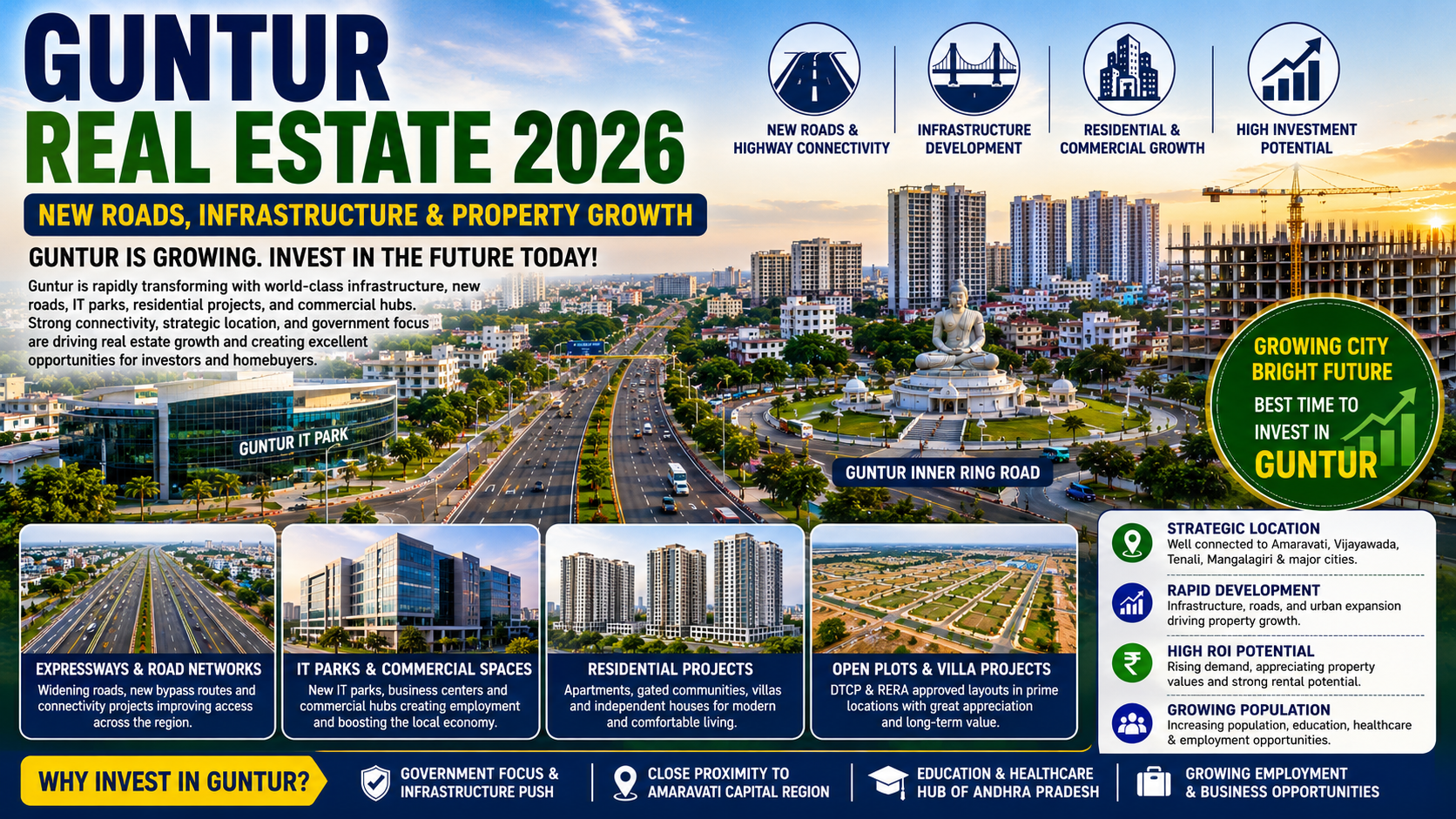
infrastructure development is influencing Guntur’s real estate landscape. Better roads and urban expansion could create new residential and commercial opportunities in developing areas around the city.
## Guntur Real Estate 2026: New Roads, Infrastructure & Property Growth
Guntur is emerging as one of the important real estate and urban development destinations in Andhra Pradesh, with growing activity across residential, commercial, infrastructure, and land development sectors. The city’s strategic location, improving road connectivity, proximity to Amaravati, and expanding urban infrastructure are creating new opportunities for property buyers, investors, developers, and businesses. As development continues around the Guntur–Amaravati region, several areas are attracting increased attention for residential projects, open plots, commercial properties, and future investment opportunities.
One of the key factors supporting Guntur’s real estate growth is the development of **roads and transportation infrastructure**. Better connectivity between Guntur, Amaravati, Vijayawada, Tenali, Mangalagiri, and surrounding regions is helping improve accessibility and supporting the expansion of the city. New road improvements, widening projects, junction development, bypass routes, and connectivity corridors can make previously developing locations more accessible and increase their potential for future urban growth.
The connection with **Amaravati**, the capital region of Andhra Pradesh, is another major factor influencing Guntur’s property market. Guntur’s close proximity to Amaravati gives the city an important advantage as residential and commercial activity expands across the wider capital region. As government offices, institutions, infrastructure projects, businesses, and supporting services develop in the capital area, demand for housing and commercial facilities in nearby cities and suburbs could also increase.
Guntur is also experiencing continued growth in **residential development**. Apartments, gated communities, independent houses, villas, and plotted developments are expanding across different parts of the city and its surrounding areas. With urbanisation and population growth, homebuyers are increasingly looking for locations that provide good road connectivity, schools, hospitals, shopping facilities, employment opportunities, and easy access to major highways.
The **commercial real estate sector** is another area to watch. As residential communities expand, demand for retail shops, office spaces, restaurants, educational facilities, warehouses, and other commercial properties can increase. Development of commercial hubs along major roads and growing residential corridors could gradually create new business centres outside the traditional core areas of Guntur.
Open plots and land investments are also receiving attention from investors looking at the long-term development of the region. Locations with planned infrastructure, established connectivity, nearby residential growth, and access to major roads may have stronger development potential. However, investors should carefully verify land titles, approvals, zoning regulations, road access, development plans, and other legal documents before purchasing any property.
Another important factor is the growth of **social infrastructure**. Schools, colleges, hospitals, shopping centres, hotels, restaurants, financial services, and recreational facilities contribute significantly to the attractiveness of a location. As more residential and commercial projects come up, supporting infrastructure is also likely to expand, making developing areas more suitable for long-term living and business activity.
Guntur’s location within an important agricultural and economic region also provides a strong base for commercial activity. The city serves as a major centre for education, healthcare, trade, agriculture-related businesses, and services. Improved transportation infrastructure can further strengthen its connection with surrounding districts and major cities, potentially supporting logistics, warehousing, retail, and other business activities.
For real estate investors, **2026 could be an important period to closely monitor Guntur’s development landscape**. Instead of focusing only on current property prices, investors should examine long-term factors such as infrastructure plans, connectivity, surrounding development, employment opportunities, population growth, upcoming commercial projects, and government-approved development plans. Areas experiencing genuine infrastructure-led growth may offer stronger long-term prospects than locations based purely on speculative expectations.
The expansion of the **Guntur–Amaravati growth corridor** could also influence future property demand. As infrastructure improves and development spreads across the region, previously less-developed areas may gradually become integrated into the wider urban network. This could create opportunities for new residential communities, commercial centres, educational institutions, hospitality projects, and other supporting developments.
At the same time, buyers should approach real estate investment carefully. Property growth is not guaranteed simply because a road or infrastructure project has been announced. The actual progress of projects, government approvals, construction timelines, connectivity, local demand, and market conditions should all be considered before making an investment decision. Conducting proper legal and financial due diligence is essential, particularly when purchasing plots or land in developing locations.
Overall, **Guntur Real Estate 2026** presents an interesting combination of infrastructure development, improving connectivity, residential expansion, commercial growth, and its strategic relationship with Amaravati. With roads and urban infrastructure continuing to shape the region, Guntur has the potential to become an increasingly important residential and commercial market in Andhra Pradesh.
As the city expands, the real estate landscape is likely to evolve beyond the traditional urban limits, creating new development corridors and investment destinations. For homebuyers, developers, and investors, keeping track of infrastructure projects and locality-wise development will be crucial to understanding where the next phase of Guntur’s property growth could take place.